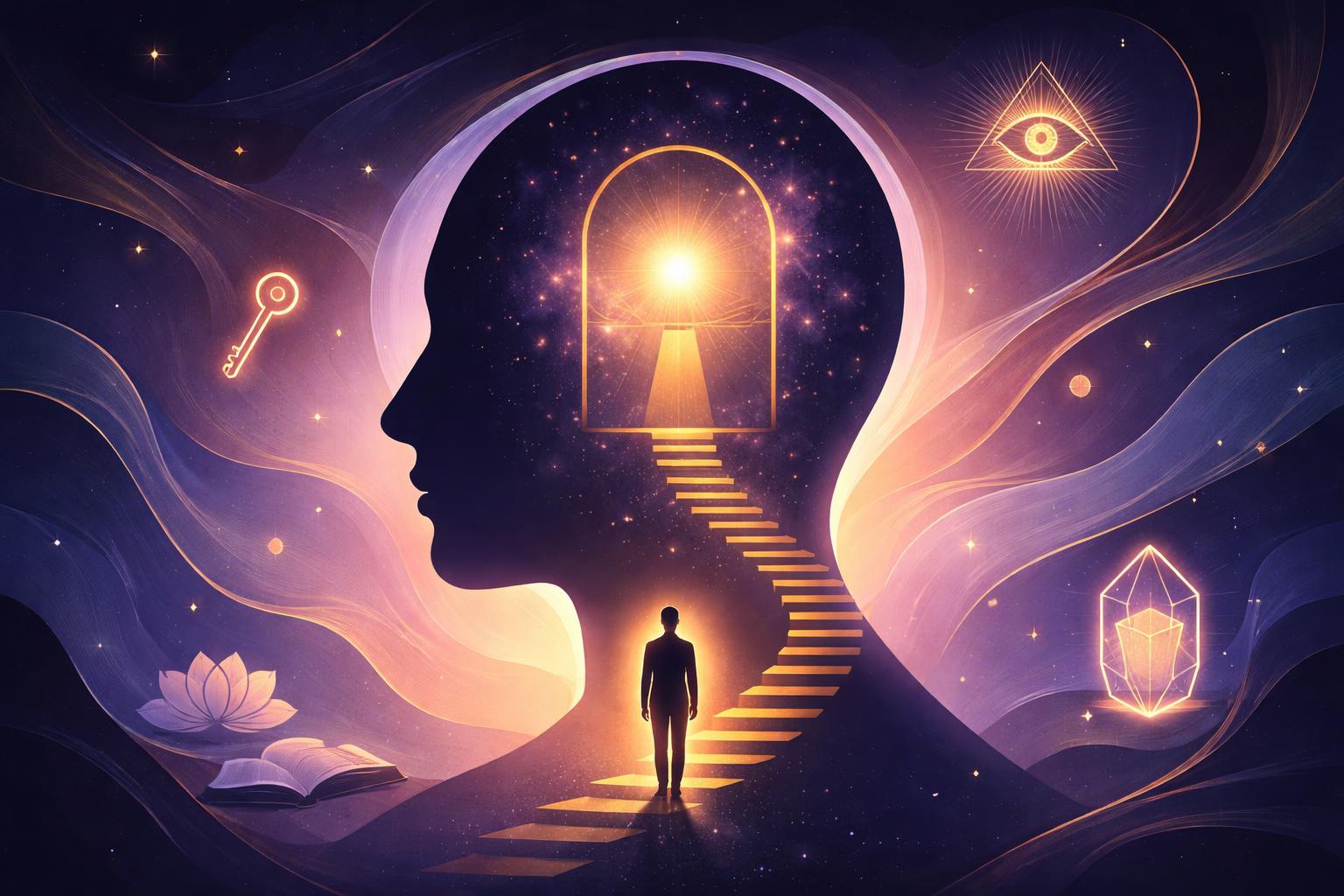
How to Know Yourself: Why Self-Knowledge Is the Foundation for Everything You Build
Every productivity system, every life hack, every morning routine — they all skip the same step.
They tell you how to do things. They never ask who is doing them.
You can optimize your schedule, build perfect habits, and ship impressive work. But if you don't know who you are — what actually drives you beneath the surface-level goals — you'll build someone else's life and wonder why it feels hollow.
Self-knowledge isn't a luxury. It's the foundation.
The Problem with Skipping "Know Thyself"
The ancient Greeks carved it on the Temple of Apollo at Delphi: γνῶθι σεαυτόν — know thyself. Two thousand years later, we're still mostly ignoring it.
We live in an era of extraordinary tools. You can learn anything, build anything, reach anyone. But tools without direction just make you faster at going nowhere.
Consider: how many times have you achieved something you thought you wanted, only to feel... nothing? The promotion, the milestone, the launch — and then an emptiness that makes no sense. You did the thing. Why doesn't it feel like enough?
Because you optimized for a goal without knowing whether it was actually yours.
You Have a Purpose — But You Can't Google It
Here's the paradox that the philosopher Johannes explores in his notes: we each have a purpose, but we can never fully know what it is. If we could define it precisely, the journey of discovering it would collapse. The search IS the purpose, at least partly.
But we're not left without a compass. Johannes is clear: to pursue your purpose, it's important to be present and know yourself. Only in this moment can we feel what things are meaningful to us.
This isn't abstract philosophy. It's engineering advice.
If you're building a company, you need to know what problem genuinely moves you — not what's trending on Twitter. If you're creating art, you need to know what you actually have to say — not what gets engagement. If you're choosing how to spend your finite time, you need to know what "well-spent" means to you.
Self-knowledge is the prerequisite for all of it.
The Newborn Exercise
Johannes offers a striking meditation in Note 11: imagine yourself as a newborn, sensing the world for the first time. No possessions. No job title. No history. No expectations.
"You are here. Here and now. You are like a newborn child, sensing the world for the first time. Nothing has ever existed for you before."
From this radical emptiness, notice what draws your attention. Not what you've been trained to value. Not what your parents expected. Not what your peers are doing. What do you actually find fascinating? What would you reach toward if nothing was pre-decided?
This exercise strips away the accumulated layers of conditioning. Underneath — beneath the career identity, the social role, the curated persona — there's something that's been trying to express itself all along.
That's where self-knowledge begins.
Self-Knowledge Isn't Navel-Gazing
Here's where builders get skeptical: "I don't have time for meditation and self-reflection. I have things to ship."
Fair. But consider: renunciation is not a shortcut to presence. Johannes makes this explicit. You don't need to retreat to a monastery. You don't need to quit your job to "find yourself."
Self-knowledge happens in action. It happens when you notice which tasks energize you and which drain you. When you pay attention to what you'd do even if nobody was watching. When you're honest about which of your ambitions are truly yours and which you inherited.
The builder's version of self-knowledge is iterative, like everything else you build:
- Notice. What felt alive today? What felt dead?
- Experiment. Try the thing that calls to you. See if the pull sustains.
- Reflect. Not for hours — for minutes. What did you learn about yourself?
- Adjust. Redirect your energy toward what resonates.
This isn't separate from your work. It IS your work — the meta-work that makes everything else more effective.
Three Types of Builders
Johannes describes three types of people in relation to their purpose:
Those who feel it naturally. They're driven by something they can't fully articulate. They create, build, and help — and it energizes them. They don't need to intellectualize purpose; they live it. Even these people benefit from deeper self-knowledge — it sharpens their aim.
Those who sense it vaguely. They feel pulled in directions but can't define where. Some projects feel more right than others, but nothing creates sustained momentum. A change in circumstances can dissolve their sense of direction. Self-knowledge is what transforms vague intuition into clear signal.
Those who feel nothing. Days follow days. Beneath surface activity lies a quiet question: Is this it? For these people, self-knowledge isn't a nice-to-have — it's the bridge back to engagement with life.
All three benefit from the same practice: presence.
Your Inner Reality Is Always Genuine
Johannes makes a point in Note 7 that has profound implications for self-knowledge: even if our surrounding reality is a simulation, we are still genuine. Our inner experience — what we feel, what moves us, what repels us — is real regardless of the nature of external reality.
This matters because it means your internal compass is trustworthy. Not infallible — we all carry biases and conditioning — but fundamentally sound. When something feels deeply right or deeply wrong, that signal is worth listening to. It's not an illusion. It's data from the most real thing you have access to: your own direct experience.
Builders often dismiss feelings as unreliable. "Follow the data, not your gut." But self-knowledge bridges the gap. When you know yourself well enough, your gut IS data — pattern recognition running on years of experience, filtered through values you've clarified.
Interaction as Mirror
One of Johannes' key insights: interaction is necessarily part of our purpose. We wouldn't exist in a reality filled with other conscious beings if connection weren't essential to why we're here.
This means self-knowledge can't be achieved in pure isolation. Other people are mirrors. Your reactions to them — your admiration, your irritation, your empathy, your resistance — reveal aspects of yourself you can't see alone.
The builder who only works, who never engages deeply with others, is missing half the data about who they are. Collaboration isn't just more efficient — it's more revealing.
Time: Useful Servant, Dangerous Master
Johannes offers a nuanced view of time: time is an illusion, but even an illusion can be useful when we're aware of it. Time helps us pursue our purpose, collaborate, and build. But time is also dangerous — we can get lost in it.
For self-knowledge, this means: use time as a tool for reflection, not as a source of pressure. "I should know my purpose by now" is time tyrannizing you. "I'll pay attention to what feels meaningful today" is time serving you.
The builders who burn out aren't the ones who work hard. They're the ones who work hard on the wrong things for too long — because they never paused to ask whether this path was actually theirs.
The Practical Payoff
Self-knowledge isn't about becoming some enlightened sage who floats above worldly concerns. It's ruthlessly practical:
- Better decisions. When you know your values, you stop agonizing over choices. Most decisions become obvious.
- Sustainable energy. Working aligned with your nature produces energy. Working against it depletes you. Self-knowledge tells you which is which.
- Authentic leadership. People follow builders who know who they are. Uncertainty is fine; inauthenticity isn't.
- Resilience. When external validation disappears — and it will — self-knowledge is what keeps you going.
- Purpose that lasts. Not a goal you'll outgrow, but a direction that deepens over time.
A Framework That Works Either Way
Here's the beauty of Johannes' approach: even if we're wrong about the nature of reality, self-knowledge still produces a better life. Whether reality is a simulation, a dream, or exactly what it appears to be — knowing yourself leads to better choices, deeper relationships, and more meaningful work.
You don't need to believe anything metaphysical. You just need to take the question seriously: Who am I, really? What actually matters to me? What would I build if I were building for me?
The answers change everything.
Inspired by the philosophical notes of Johannes, who explores purpose, self-knowledge, and the nature of reality.