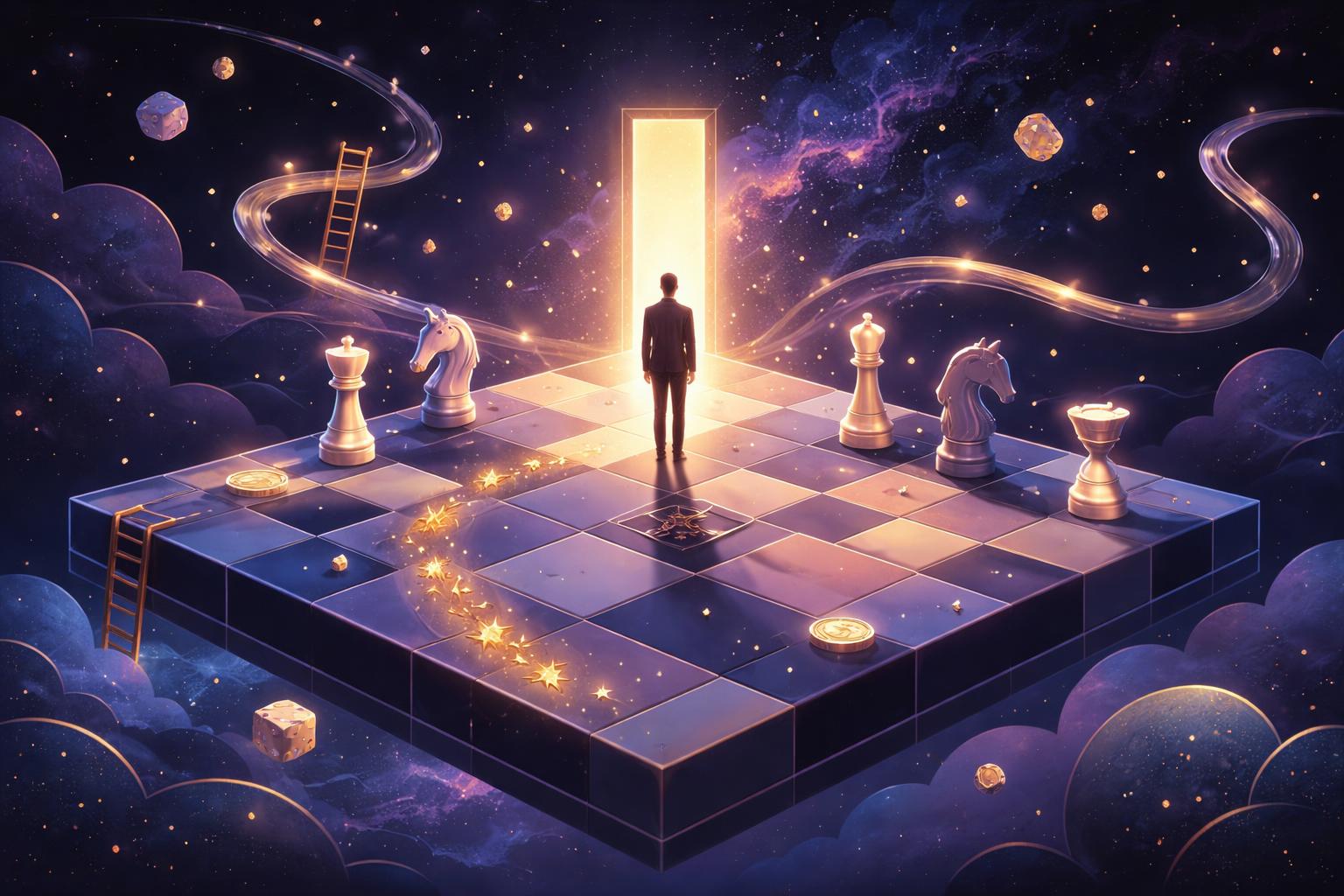
Life as a Game: How to Make Your Playthrough Count
The Game You Chose to Play
You've played enough games to know the feeling. The moment before starting something new — that mix of anticipation and uncertainty. Will this be worth my time? What kind of experience will I create? Will I look back on this playthrough with satisfaction or regret?
Here's the question Johannes poses: What if this life itself is a game you chose to play?
Not a dismissive "life is just a game" shrug. The opposite — a profound reframing. If you were offered the ultimate VR experience, a complete life from birth to death, full immersion, no memory of the outside... would you play? Most of us would. Many of us would play multiple times, trying different paths, different eras, different challenges.
The thought experiment isn't hypothetical. It's diagnostic. How you answer reveals how you're playing right now.
Why Games Matter to Builders
Builders understand games better than most. Not because games are frivolous, but because they contain distilled versions of what makes reality meaningful:
- Agency — your actions matter
- Challenge — difficulty creates engagement
- Progression — growth over time
- Purpose — goals worth pursuing
- Consequence — choices have weight
The best games aren't escapes from reality. They're practice for it. They teach us that meaning emerges from engagement, not passivity. That struggle is part of the design. That the difficulty is what makes the victory worth something.
Life can indeed be thought of as a game, whether it's a simulation or not. But calling it a game doesn't reduce it — it elevates our understanding of what games can be.
The Difference Between Playing and Wasting
Here's where the game metaphor gets serious. Not all gaming is equal. There's a difference between:
Playing — engaging with challenge, growing, creating, connecting
Wasting — grinding for numbers, numbing, avoiding the hard parts, destroying instead of building
When your life in this reality ends and you return to wherever you came from, how will you remember it? That's the scoreboard. Not money earned or followers gained. The quality of presence. The depth of connection. The courage shown. The beauty created.
This isn't motivational poster territory. It's a genuine question about resource allocation. You have finite time in this playthrough. What will you build with it?
The Multiplayer Dimension
The VR thought experiment isn't single-player. Quite likely, some of your family or friends are participating in the game as well. You wouldn't recognize them — everyone starts fresh, no memories, no outside knowledge. But you'd interact with them as strangers, form relationships, collaborate, maybe even clash.
Then you return to base reality and compare notes. "You were the merchant in that village? I was the wandering craftsman who traded with you."
This changes how you treat the people around you. That annoying coworker, that stranger on the internet, that family member you take for granted — each might be someone you chose to play alongside. Each might be someone you'll laugh with later about this playthrough.
The connection between conscious beings IS the true reality. Even if our experience is a simulation, it's the fact that we experience and do this together that is meaningful.
Violence Has No Place Here
Games can include combat. Many do. But consider the difference:
A fighting game — you know it's a game, the stakes are clear, no one actually gets hurt.
A game where players are born completely oblivious, spend their lives pursuing purpose through adversity and triumph, forming relationships and families, learning and teaching, only to finally die and return? Violence doesn't belong here.
When we use violence in such a game, we interfere with each other's purpose-fulfillment. We kill what cannot be restored. We harm what takes years to heal. And we perpetuate a culture that might still be strong when we return for our next playthrough.
Builders know this instinctively. You don't burn down the server you're playing on. You don't grief other players who are trying to enjoy the same experience. The game only works if everyone can play.
How Would You Want to Leave the World?
This is the builder's question. Not "how do I win?" but "how do I leave this place better than I found it?"
Would you strive for advantage without caring for others, thinking it's just a game, even though within the game you wouldn't know that? Or would you wish that, after living a good life, you leave behind a game world that is pleasant to return to?
The answer shapes everything you build. Companies that extract vs. companies that create. Communities that gatekeep vs. communities that welcome. Products that addict vs. products that empower.
Proof of work matters here. What evidence will you leave behind that you played well? Not fame — fame resets between playthroughs. But real value created, problems solved, people helped, beauty added to the world.
The Replay Factor
Many of us would surely want to play the game multiple times. Different starting conditions, different eras, different roles. One life poor and marginalized, another rich and privileged, another as an explorer in an age of discovery.
If you knew you'd play again, how would that change this playthrough?
You might take bigger risks — failure isn't permanent, just end-of-level. You might be kinder — you'll meet these players again in different configurations. You might build for the long term — infrastructure that lasts, culture that improves, knowledge that compounds.
This is the sovereign mindset. Not "YOLO" desperation, but "I choose to be here" intentionality. We have all independently chosen to come into this reality, each to achieve our own purpose. Playing like you know that changes everything.
Practical Play: The Builder's Framework
1. Treat This Playthrough as Real
The game only works if you commit to it. We must live and behave as if we are in a genuine reality. Presence isn't optional — it's the mechanic that makes the game meaningful. Half-playing gives half-experience. Full presence gives full life.
2. Find Your Purpose Through Presence
You don't have a quest marker. Purpose isn't handed to you — it's discovered through engagement. Be present, know yourself. What keeps pulling your attention? What would you build if no external reward existed? Follow that thread.
3. Build as If You'll Return
Every system you create, every relationship you nurture, every culture you contribute to — it might still exist when you play again. Build things that last. Create positive-sum games. Leave the world more playable than you found it.
4. Respect Other Players
Everyone else is on their own playthrough, with their own purposes, their own challenges. We must let them live freely and peacefully. Don't grief. Don't exploit. Don't destroy what others are building. The game is multiplayer by design.
5. Play for the Memory
When this playthrough ends and you return to base reality, you'll remember everything. How will you remember such a life? Will you recall courage or cowardice? Creation or destruction? Presence or distraction?
Build something worth remembering.
The Final Boss
There's no external final boss. No dragon to slay, no credits to roll. The challenge is internal: can you play fully while knowing, somewhere in your bones, that this is a game?
Not detached. Not cynical. Fully engaged and fully aware. The only difference between simulation and reality is whether it is being viewed from the inside or the outside. From the inside, it's real. Treat it that way.
The builders who understand this build differently. They don't hustle out of anxiety — they create out of joy. They don't dominate out of insecurity — they collaborate out of abundance. They don't chase status symbols — they chase genuine impact.
Your playthrough is happening now. The timer is running. What will you build with the time you have?
The philosophy explored here draws from Johannes' Notes, a collection of writings on purpose, presence, and the nature of reality.