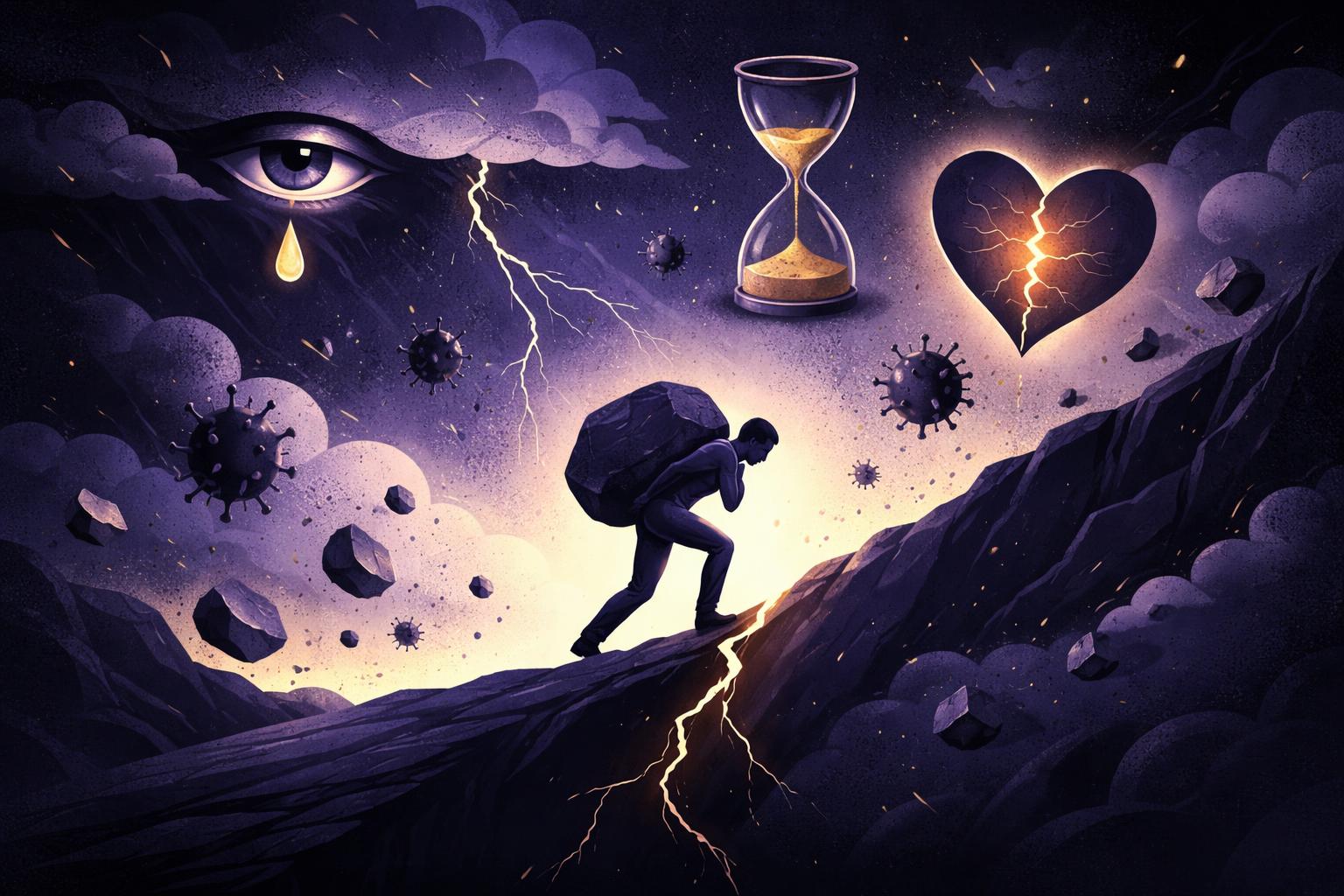
Why Is Life So Hard? What Your Struggles Are Actually For
You're exhausted. Not just physically — that bone-deep exhaustion where you question why any of this matters. The project that keeps breaking. The relationship that won't heal. The gap between where you are and where you thought you'd be by now.
Why is it so hard?
This isn't a rhetorical question. You've probably typed it into a search bar at 3 AM, or whispered it to yourself in the car, or thought it while staring at a ceiling that has no answers. And you deserve more than platitudes about growth mindsets and silver linings.
So here's something different: what if the difficulty is the point?
You Chose the Hard Mode
Consider a strange possibility. We have chosen to enter this reality, fully aware that life here is different and often difficult and challenging. Not chosen in a casual way — chosen with the full understanding that this would not be easy.
Why would anyone do that?
Think about it from the other direction. If you could live any experience — truly any — would you always choose comfort? Or would you sometimes choose the mountain, the marathon, the challenge that pushes you past what you thought you could handle?
The people who build things understand this instinctively. No one starts a company because it's easy. No one writes a novel, ships an app, or raises a child because they wanted a smooth ride. They do it because something in them knows that the struggle is where the meaning lives.
The Cost of Throwing It Away
When life gets brutal, the temptation is to quit. Not necessarily in the dramatic sense — sometimes quitting looks like checking out. Going through the motions. Numbing yourself with whatever's available. Letting the days blur into a beige streak of half-presence.
If we were to throw away this life because it is unpleasant, difficult, or boring, or if we feel that we have failed or are being mistreated, we would be abandoning everything that we came here for. This hits different when you really sit with it.
You're not just wasting time. You're wasting the specific, unrepeatable opportunity that this particular struggle represents. The lesson it carries. The strength it's building. The version of you that exists on the other side of it.
Difficulty Is Not Punishment
Here's where most frameworks fail. Religion says suffering is punishment or testing. Self-help says it's a growth opportunity (with a smiley face). Nihilism says it's meaningless noise.
But there's a fourth option: difficulty is the texture of a meaningful experience. It's not punishment, and it doesn't need to be reframed as positive. It's simply what a fully lived life feels like.
Perhaps we wanted to learn something. Maybe this particular experience was missing among our numerous experiences, and we wanted to see this side of life as well. Your specific struggles — the ones that feel uniquely, cruelly yours — may be exactly the experiences you needed.
Not because suffering is good. Because depth requires range.
Fear Makes It Harder Than It Needs to Be
Here's the thing about difficulty: it has a multiplier, and that multiplier is fear.
The actual hard things — building something from nothing, loving someone fully, confronting what isn't working — those are hard. But they become crushing when you add the fear of failure, the fear of judgment, the fear of loss.
We did not come here to be afraid. We came here to live, and if we fear, we cannot truly live. Fear doesn't protect you from difficulty. It just makes sure you suffer the difficulty twice — once in anticipation, once in reality.
Fearlessness does not mean irresponsibility. Responsibility stems from meaningfulness, purpose, and love. The builders who endure aren't the ones who feel no fear. They're the ones who refuse to let fear add unnecessary weight to the load they're already carrying.
The Struggle That Builds
There's a difference between suffering and struggle. Suffering is passive — it happens to you. Struggle is active — you engage with it, push against it, shape yourself through it.
Builders know this. Every shipped product is a monument to a hundred solved problems. Every working system is the visible surface of invisible struggle. The code that runs cleanly went through iterations that didn't. The business that works rests on a foundation of attempts that failed.
Will you waste your game? Use it to destroy yourself or others? Or will you make it your best life ever? This isn't motivational poster material. It's a genuine question with a deadline. Your life has a finite number of days, and each one spent in pure avoidance is one that can't be reclaimed.
When It's Too Hard
Let's be honest about something. There's a line between productive struggle and genuine crisis. If you're in so much pain that you can't function, this article isn't what you need — you need another human being. A therapist, a friend, a crisis line. Reach out. That's not weakness. That's using every resource available, which is exactly what a builder does.
But if you're in that more common place — the long, grinding difficulty that makes you question everything — then consider that this might be exactly where you're supposed to be. Not because the universe is teaching you a lesson, but because you chose an experience that required this passage.
When you stop being afraid, your old self dies, and you are born again into this life. Sometimes the hardest part of struggle isn't the struggle itself. It's letting go of the person you were before it started.
What to Do When Life Is Hard
No seven-step program. Just what actually works:
Stop asking why me. Instead ask: what is this building in me? What capacity am I developing that I didn't have before? The question isn't why the weight is heavy — it's what muscles it's creating.
Stay present. The hardest part of difficulty is usually the story around it — the catastrophizing, the comparison, the projection into a terrible future. The actual present moment, even a hard one, is survivable. This moment is the only thing that is certainly true for us.
Build something. When everything feels like it's falling apart, create something. Anything. Write, code, cook, plant, fix. The act of building is an act of defiance against despair. It says: I'm still here, and I'm still making things.
Remember it ends. Not in a morbid way — in a liberating way. This specific difficulty has a lifespan. You will come out the other side. And when you do, you'll carry something that people who avoided the struggle will never have.
Connect. Difficulty in isolation becomes despair. Difficulty shared becomes a bond. Find someone who's building through their own hard thing, and build alongside each other.
The View From the Other Side
Every builder has a story about the project that almost broke them. The one that was too hard, too complex, too ambitious. And every one of them will tell you the same thing: that project — the one that nearly destroyed them — is the one they're most proud of.
Not because suffering is noble. Because they showed up for the full experience. They didn't quit when it got hard. They didn't numb themselves into half-lives. They built through it.
When your life in this reality eventually ends and you return to wherever you came from, how will you remember such a life? When you look back on the hard parts — and you will — let them be chapters in the story of someone who stayed present, who kept building, who treated the difficulty as material rather than obstacle.
Life is hard. That's not the problem. The problem is believing it shouldn't be.
It should be. And you're equal to it.